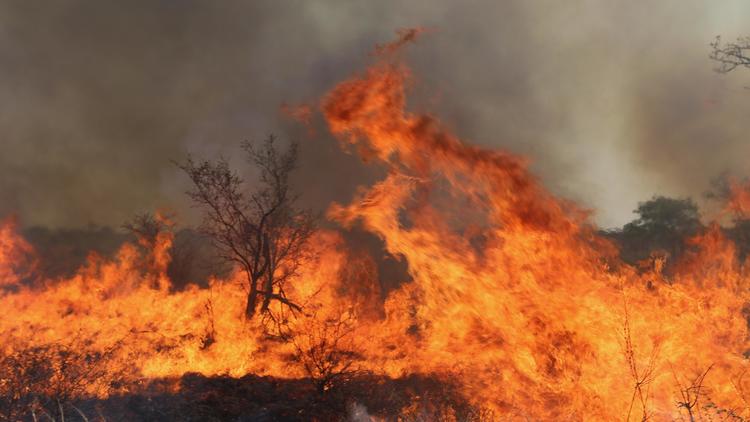
Our work focuses on the dynamics and distribution of biomes, especially within and at the intersection of savanna and forest. We use a combination of empirical and modeling approaches to understand how tree-grass interactions with their resource environment (soil and climate) and disturbances (fire and herbivory) scale up to predict landscape- and continental-scale patterns in tree cover and the distributions of biomes. I am especially interested in the idea that historical ecological patterns are fundamental drivers determining current and future distributions of ecological pattern. Hysteresis and historical contingencies are major, but relatively under-appreciated, determinants of ecological dynamics. We are also involved in improving our understanding of what these dynamics may mean both for savanna biodiversity and for their contributions to the global carbon cycle, both of which have been historically neglected. We are focused primarily in savannas in South Africa (especially Kruger and Hluhluwe iMfolozi Parks) and Brazil, but we are also involved in ecosystems throughout the global tropics and subtropics.
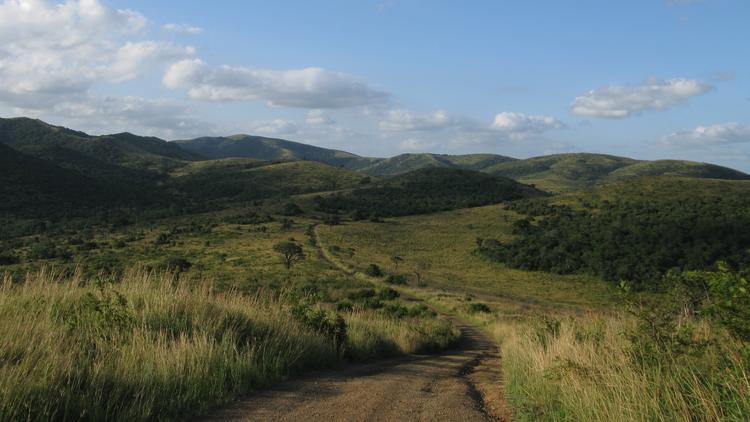
The distribution of savanna and forest
Understanding what determines vegetation distributions on Earth is critical for predicting biosphere responses to global change. Since Humboldt, ecologists have recognized that climate shapes vegetation, but we increasingly acknowledge that the relationship is not strictly deterministic. The strongest departures are dynamic systems where vegetation-environment feedbacks are significant – such as savannas. My work has shown that, over large parts of their range, savannas persist where climate can support forests because fire limits tree cover. Low tree cover in turn facilitates the accumulation of grass biomass, which fuels frequent fires. Thus, savannas may represent a stable alternative to forests, maintained by positive feedbacks with fire and perhaps also herbivory. We are currently working on approaches to evaluate temporal predictions of savanna-forest bistability, and on the formation of complex spatial patterning in savanna-forest mosaics.
Carbon cycling and storage in savannas
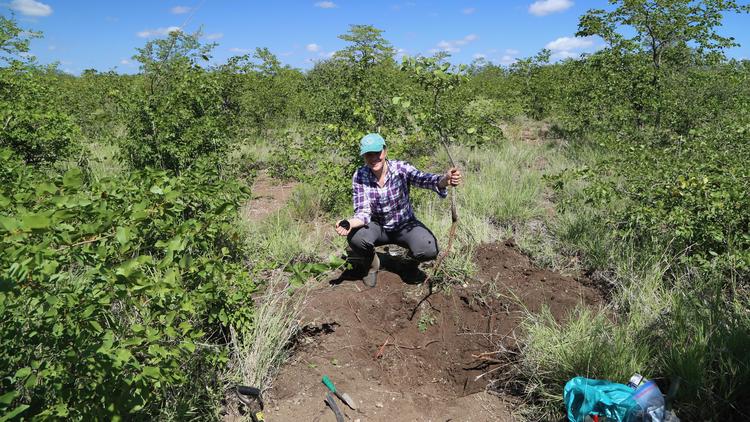
Savannas are ancient ecosystems, home to biodiversity that is uniquely adapted to and dependent on chronic disturbances from fire and herbivory. Historically the status of savannas as ancient ecosystems was questioned, however, and thus basic aspects of savanna ecosystem dynamics, including carbon storage and cycling, have been neglected. For example, belowground carbon storage (in roots and soils) may be substantial in savannas, making this an important unstudied dimension of savanna carbon cycling. My lab has been developing methods to more easily quantify savanna roots, to standardize sampling of soil organic carbon, and to evaluate how interventions aimed at storing carbon actually affect savanna carbon storage and cycling. We are also interested in how changes in the savanna carbon cycle interact with conservation of endemic savanna biodiversity.
Herbivory, from communities to ecosystems
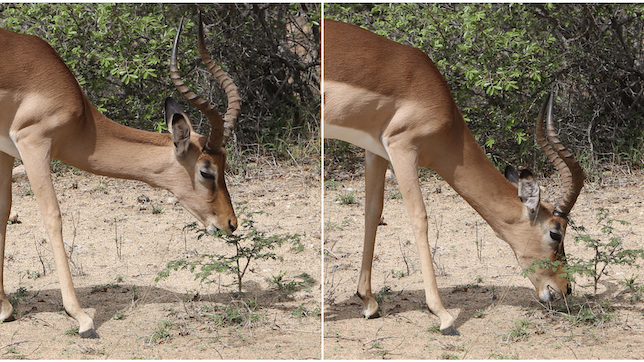
Savannas are perhaps best known for their large-mammal biodiversity (e.g., in Serengeti and Kruger National Parks) and, in agriculture, are widely used for livestock production. While it is well known that both wild and domesticated herbivores can impact vegetation, a quantitative theory of herbivore impacts is incipient, in part because the diversity of herbivores and herbivore feeding strategies has obscured generalization. My lab is actively engaged in herbivory-related research in savannas, combining work with herbivore exclosures, diet estimation, metabolic scaling theory, and other approaches to improving our quantitative understanding of herbivory in savannas.
Fire in the Earth System
Fire represents a major and increasingly important process influencing vegetation dynamics and carbon cycling in the Earth system. In savannas and other fire-dependent ecosystems, fire is not an intrinsic problem, but changes in fire occurrence and management remain poorly understood. My lab is working on understanding changes in fire occurrence and behavior in fire-prone ecosystems, focusing on how climate and management interact to affect fire behavior. We are also interested in how management for smaller, cooler fires, motivated by calls to reduce fire activity for carbon sequestration, may be aggravating woody encroachment and biodiversity loss in savannas.